

How Transparent LED Film Screen Works:Complete Guide
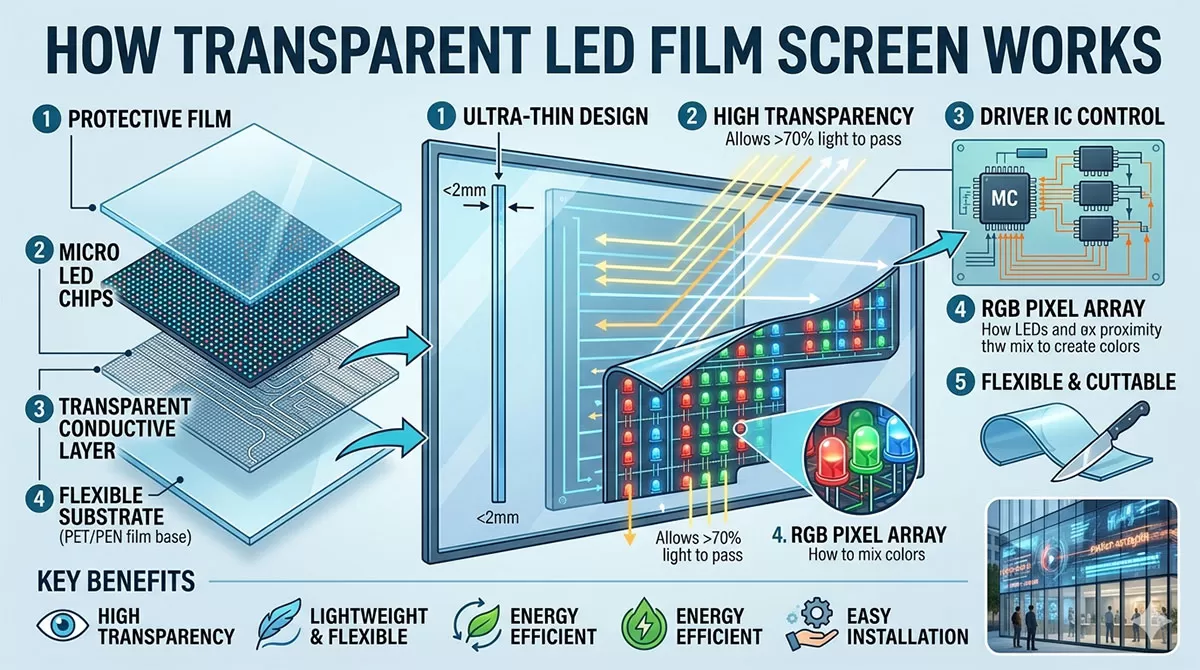
If you've ever seen a glass window display video content while remaining see-through, you've witnessed transparent LED film screen technology in action. But how exactly does it work — and why doesn't the film block the view behind it?
This guide breaks down the technology from the ground up: the structure of the film, how light passes through, how it connects to a video source, and what the key performance metrics mean in practice.
What Is Transparent LED Film Screen?
A transparent LED film screen is a thin, flexible panel — just 2.0 mm thick — that applies directly to glass surfaces such as windows, curtain walls, and glass partitions. Unlike conventional LED displays that block the view entirely, transparent LED film maintains visibility through the glass while displaying dynamic content on top of it.
The film consists of three core components: a transparent flexible substrate (usually PET polymer), an array of micro-LED chips mounted at regular intervals, and a thin conductive circuit layer that delivers power and data signals to each chip.
Because the LED chips are small and spaced apart, they occupy only a fraction of the film's surface area. The remaining open space between chips allows natural light and the view beyond the glass to stay visible. This spacing principle is the fundamental mechanism behind the technology.
For a broader overview of the product family and available configurations, see our Transparent LED Film Screen product page.
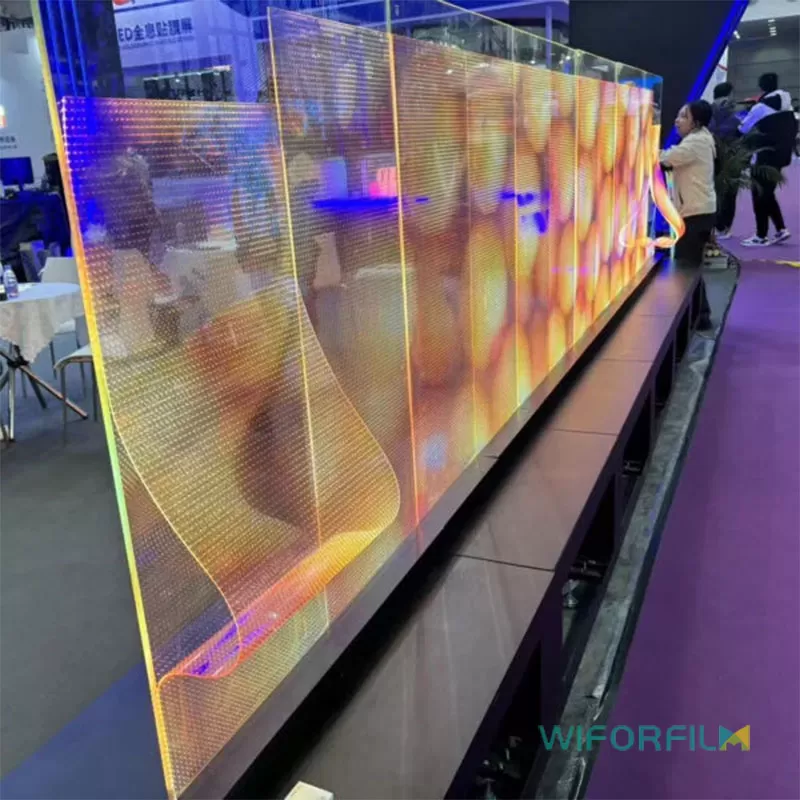
The Core Technology: Four Patented Innovations Behind the Transparency
Most transparent LED film products on the market trade off transparency for image quality. Achieving both simultaneously requires rethinking the chip, the circuit, the adhesive, and the drive method — all at once. Our film addresses each layer through proprietary, patented technology. Here is how each innovation works and why it matters.
1. Integrated MiniLED lamp beads
Conventional LED film uses standard surface-mount packages in which the driver circuitry and the LED chip are housed separately, with connecting traces running across the substrate surface. Those traces — however thin — reduce the open area of the film and lower its transparency.
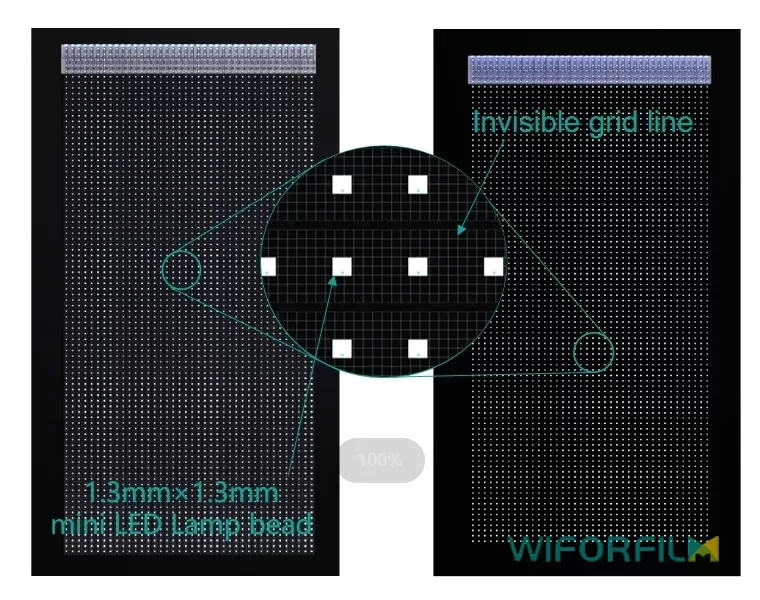
Our film integrates the driver chip directly inside the MiniLED bead itself, a patented design that eliminates the external circuit connections between driver and emitter. The result is a physically smaller, self-contained light source with a larger proportion of open, unobstructed film area between each pixel. This integration is the primary reason the film achieves 90–95% transparency across the full product range — among the highest measured values for any glass-mountable LED display film.
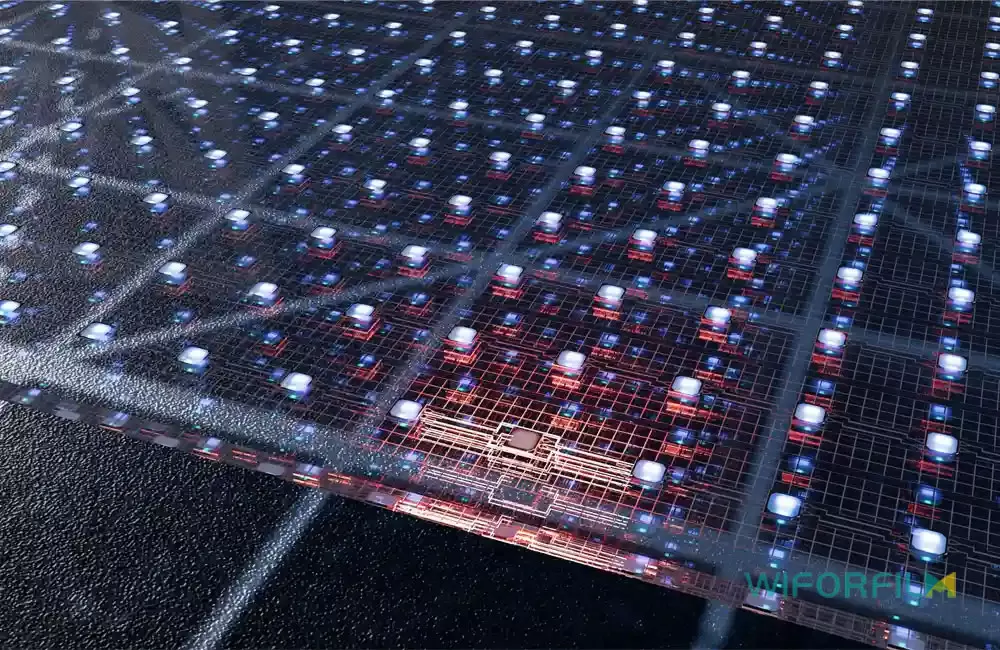
2. Invisible grid circuit design
Even with integrated chips, a display film still requires a conductive grid to deliver power and data to every pixel. In most products, this grid is visible as a faint mesh pattern — particularly noticeable when viewed in daylight from an oblique angle.
Our film uses a proprietary invisible grid circuit layout in which the conductive traces are routed to minimise visual obstruction. The circuit lines are engineered to fall within the shadow footprint of the LED beads themselves, so from any normal viewing angle the grid effectively disappears into the chip positions rather than extending across the clear film area. The transparency ratings — 90% at P4/P5, up to 95% at P20 — are measured with the circuit in place, not in isolation.
3. Self-developed chip: driver inside the bead
The self-developed chip is the foundation of both innovations above. By placing the drive IC inside the LED bead package rather than mounting it separately on the substrate, the overall circuit design is simplified: fewer external components, fewer solder joints, and a shorter signal path from controller to emitter.
This architectural simplification has three practical consequences. First, it reduces the physical footprint of each pixel node, directly contributing to higher transparency. Second, it improves signal integrity — shorter traces mean less electrical noise and more stable pixel control. Third, it reduces the number of failure points across the film, supporting the product's rated 100,000-hour lifespan.
4. Self-developed adhesive: direct glass bonding without brackets
Installation method is often an afterthought in LED film specifications — but it determines whether a project is feasible on existing glazing without structural modification. Our film uses a self-developed glue-filling process that gives the screen body its own inherent adhesive property.
The film can be applied directly to a clean glass surface without a secondary adhesive layer or mounting frame. The colloid adheres through strong molecular adsorption, and — unlike conventional pressure-sensitive adhesives that degrade over time — bond strength increases with age due to the inherent characteristics of the colloid material. This makes the adhesion more reliable over the product's lifetime, not less, and removes the installation risk associated with adhesive delamination in high-humidity or temperature-cycling environments.
How light passes through the film
The combined effect of integrated chips, invisible grid routing, and a minimal-footprint bead design means that between each pixel node, the substrate is largely open and unobstructed. When the display is off, the film is essentially invisible on the glass. When active, the LED chips emit light toward the viewer — up to 2,000–4,000 cd/m² — while the background view remains clearly visible through the gaps.
The effect is similar to looking through a fine mesh at sufficient distance: the eye integrates the open areas and the lit pixels into a coherent image. At typical architectural viewing distances of 3 metres or more, the grid structure is imperceptible. This perceptual blending is studied in detail by researchers in the field of transparent display technology.
32-level current regulation and true 16-bit greyscale
Image quality in LED displays degrades when the drive current is not precisely controlled — particularly at low brightness levels, where quantisation artefacts and colour shift become visible. Our film's RGB channels use 32-level linear current regulation, which maintains accurate colour and greyscale reproduction across the full brightness range.
Critically, true 16-bit greyscale is preserved at any current level — including the reduced currents used in indoor and semi-outdoor environments. This means the same film can be specified for an indoor retail window at low brightness and a semi-outdoor atrium at higher brightness without any compromise in image fidelity. The 32-level current linearity also ensures consistency across panels in large multi-module installations, where even small per-panel variation would otherwise be visible as brightness banding across the display surface.
How It Attaches to Glass Surfaces
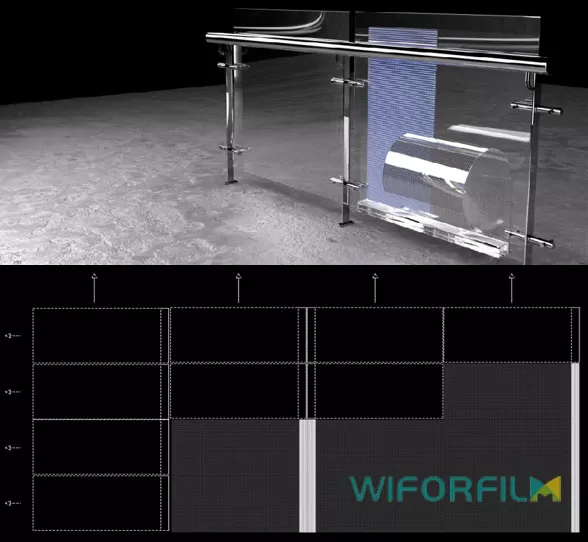
One of the practical advantages of transparent LED film screen is its installation flexibility. Unlike traditional LED light boxes that require structural mounting hardware, the film product can be directly adhered to existing glass surfaces.
- Self-adhesive backing — The most common method. A pressure-sensitive adhesive layer bonds directly to clean glass, similar to a large-format window graphic. No drilling or permanent modification required.
The film adheres to most flat glass types including tempered, laminated, and double-glazed units. Curved glass installations are possible with sufficiently flexible film products, though minimum radius limitations apply depending on the substrate specification.
Self-adhesive film can be removed without damaging the glass in most cases, making it suitable for leased retail spaces and temporary brand activations. For installation guidance specific to your project type, see our installation guide.
Signal Input & Control System
Displaying content on a transparent LED film screen requires a signal chain: a video source, a dedicated control system, and a power supply that drives the LEDs.
Video signal input
The film connects to a LED controller card (also called a receiving card or sending box) via flat ribbon cables at regular intervals along the film edge. The controller receives the video signal — typically via HDMI, DVI, or Ethernet — and converts it into the individual pixel data that drives each LED chip. This architecture follows the same principles used in professional AV integration standards.
Control system options
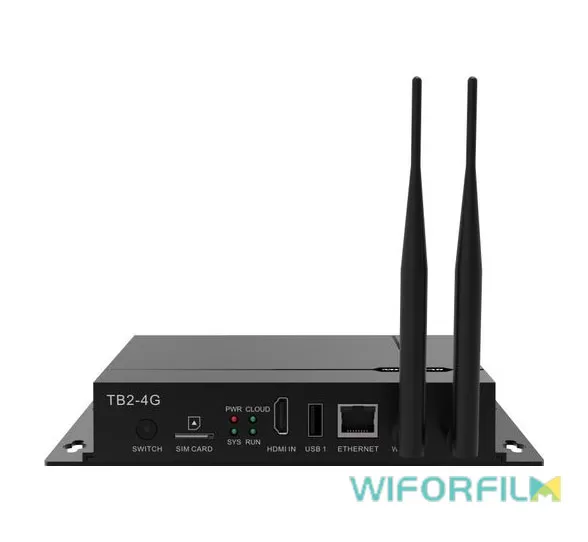
Entry-level installations use a standalone sending box that plays pre-loaded content from a USB drive or SD card. More sophisticated setups connect to a network (LAN, 4G, or Wi-Fi) for remote content management, scheduling, and real-time monitoring. Enterprise installations often integrate with digital signage software platforms for centralised fleet management across multiple screens.
Power supply
The film accepts a wide-range AC 100–240V / 50–60Hz input, making it compatible with power infrastructure worldwide without step-down transformers. Peak power draw is 600W/m²; however, real-world average consumption is 200W/m² under normal operating conditions (mixed content at typical brightness levels). Refer to our product specifications page for model-specific data.
Control system & image quality
Our transparent LED film is compatible with industry-standard control systems from Nova Star and Colorlight — the two most widely supported platforms in professional LED display installations globally. Both offer robust software for content scheduling, brightness calibration, and remote monitoring.
Image quality is further supported by a 16-bit greyscale depth and a 3,840 Hz refresh rate. The high refresh rate is particularly important for camera-facing applications such as broadcast studios, retail windows, and exhibition stands, where a lower refresh rate would produce visible flicker or banding in video footage.
Key Performance Metrics You Should Know
When evaluating transparent LED film products, five specifications determine fitness for your application. For a deeper explanation of each, see our dedicated guide on how to choose transparent LED film screen.
| Metric | What it means | Our product range |
|---|---|---|
| Transparency rate | Percentage of surface area that allows light through | 90% – 95% |
| Pixel pitch | Distance (mm) between pixel centres — affects resolution and transparency | P4 to P20 |
| Brightness | Maximum light output in cd/m²; P4/P5 suited to standard indoor environments; P6.25+ available in 4,000 cd/m² for brighter spaces | 2,000 – 4,000 cd/m² |
| Viewing angle | Horizontal and vertical range with acceptable image quality | 160° |
| Refresh rate | Screen updates per second — higher rate eliminates flicker in video/photo capture | 3,840 Hz |
| Greyscale depth | Colour gradation precision — 16-bit enables smooth transitions across 65,536 levels per channel | 16-bit |
| Peak / average power | Watts per m² — peak at full white; average reflects typical mixed-content operation | 600W / 200W per m² |
| Working environment | Safe operating temperature and humidity range | −20℃ to 55℃ / 10–90% RH |
FAQs
1. What is a LED film screen and how does it work?
LED film screen is an ultra-thin transparent display that uses micro LED pixels embedded in a flexible film, allowing video playback while keeping glass transparency.
2. How transparent is LED film screen?
Most LED film screens offer around 85%–95% transparency, meaning they can display content while still allowing natural light and visibility through glass.
3. Where can LED film screens be installed?
They are commonly installed on storefront windows, glass curtain walls, shopping malls, airports, exhibition halls, and car showrooms.
4. Can LED film screen be applied directly on glass?
Yes. It uses a self-adhesive structure, so it can be directly applied to existing glass without steel frames or structural modification.
5. What is the difference between LED film screen and traditional LED display?
LED film screens are ultra-thin, flexible, and transparent, while traditional LED displays are bulky, opaque, and require heavy installation structures.To learn more, read our detailed comparison: Transparent LED Film Screen vs Traditional LED Screen
6. Is LED film screen suitable for outdoor use?
Yes, some models support outdoor use with waterproof and high-brightness design, typically up to 5000 nits for daylight visibility.
7. What pixel pitch options are available for LED film screens?
Common pixel pitches include P4, P5, P6.25, P8, P10, P15, and P20 depending on viewing distance and resolution needs.
8. How long does a LED film screen last?
The typical lifespan is around 100,000 hours, depending on usage environment and maintenance.
9. Can LED film screen be curved or cut?
Yes, it is flexible and can be applied on curved glass surfaces, and some models can be customized in size and shape.
10. How is LED film screen controlled?
It supports software control via PC, mobile app, WiFi, or cloud systems like NovaStar, allowing remote content updates.
11. Does LED film screen affect natural light?
No, it maintains high transparency, so natural daylight and indoor visibility are not significantly blocked.
12. How much power does a LED film screen consume?
Average power consumption is relatively low, often around 200W per square meter depending on brightness and content.
13. Is LED film screen easy to install?
Yes, installation is simple—peel, stick, and connect power/data. No heavy steel structure or complex construction is required.
14. What content can be displayed on LED film screen?
It supports video, images, animations, advertising content, and real-time digital signage.
15. Can LED film screen be used for advertising?
Yes, it is widely used for retail advertising, brand promotion, and dynamic storefront digital signage.
16. How bright is LED film screen in daylight?
Brightness typically ranges from 2000 to 5000 nits, ensuring visibility even under strong sunlight.
17. Is LED film screen energy efficient?
Yes, compared with traditional LED displays, it consumes less power while maintaining high brightness and transparency.
18. What are the main advantages of LED film screen?
Key advantages include ultra-thin design, high transparency, flexible installation, lightweight structure, and strong visual impact.
19. Can LED film screen be customized?
Yes, it supports custom sizes, shapes, pixel pitches, and installation methods based on project requirements.
20. How is LED film screen maintained?
Maintenance is simple—modules can be replaced or the film can be removed from glass without damaging the structure.