

1. What Is a Transparent Flexible LED Film Screen?
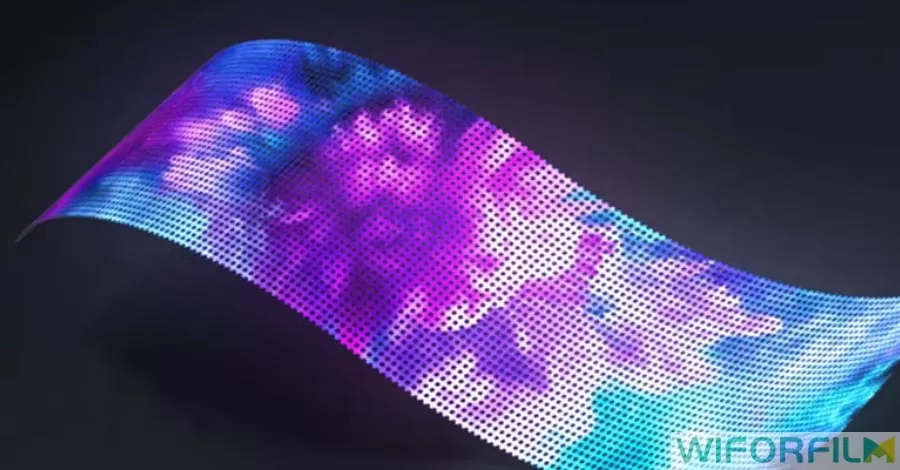
A transparent flexible LED film screen is an ultra-thin, bendable display panel that can be adhered to glass, acrylic, or other flat and curved surfaces. Unlike a conventional LED display, which is rigid and opaque, a film screen allows ambient light to pass through it — giving the impression that the display is "floating" on the surface it's attached to.
At Wiforfilm, we manufacture these panels with a total thickness often under 2 mm. The active display area is composed of thousands of individually addressable LED chips mounted on a flexible substrate, separated by transparent conductor traces. When any given LED is off, that pixel is essentially invisible. When it's on, it emits a bright, focused point of colored light.
Think of it like a fishing net made of light. The net itself is almost invisible, but when LEDs "turn on," bright nodes appear at the net intersections — while the space between nodes stays completely see-through. This technology sits at the intersection of flexible electronics, thin-film optics, and high-density LED packaging. Unlike traditional projection film or smart glass, it is a self-emitting active display that generates its own light and can reproduce full-color video at high refresh rates.
2. How Does It Actually Work? The Layer Breakdown
The film is a precision-engineered sandwich of functional layers. Here is how each layer contributes, from the outermost protective coat down to the adhesive interface with glass:
- UV-resistant protective film — Scratch-proof outer coat; blocks UV degradation of underlying electronics. Usually PET with hard coating.
- LED chip array (SMD / COB) — Micro RGB chips spaced at defined pitch intervals. Each chip equals one pixel. Pitch determines resolution and transparency.
- Transparent PCB substrate — Thin flexible circuit board made from PET or polyimide film; routes power and data signals to each LED.
- Transparent conductor traces — ITO (Indium Tin Oxide) or nano copper mesh carries current invisibly between chips, with visible-light transmittance above 85%.
- Optical Clear Adhesive (OCA) — Crystal-clear bonding layer that attaches film to glass with no air gap. Air gaps cause haze and refraction artifacts.
- Glass / surface substrate — The customer's existing glass pane, storefront window, or rigid panel surface.
The critical engineering challenge is keeping layers 2–4 both electrically conductive and optically transparent. Inferior products use conventional copper foil traces that are visible as a grid pattern to the naked eye even when all LEDs are off. The signal driving each LED pixel comes from a controller board connected via flat flex cable, using a PWM (Pulse Width Modulation) signal chain to control brightness per channel. If you'd like a deeper technical walkthrough of the full signal path and driver architecture, we've covered it in detail in our guide: How Do Flexible LED Transparent Film Screens Work?
3. Key Technical Specifications Explained
Pixel Pitch
Pixel pitch is the center-to-center distance between two adjacent LED pixels, measured in millimeters. A lower pitch number means more pixels per square meter — sharper image, higher cost, and slightly lower transparency. Our film products range from P4 to P20 depending on viewing distance and application.
Pixel density formula: Pixel density (px/m²) = (1,000 ÷ pitch_mm)² — For example, a P10 film has 100 × 100 = 10,000 pixels per square meter. A P5 film has 40,000 pixels/m² — four times the resolution at the same physical area.
Transparency Rate
This is the percentage of ambient light that passes through the film when LEDs are off. It is measured as optical transmittance per the ASTM D1003 standard. Our film products achieve 85–95% transparency — a window-film display at 90% transmittance looks and feels very close to untreated glass from inside the building.
Brightness
Measured in cd/m² (nits), brightness determines outdoor readability. For a film screen on a south-facing facade in direct sunlight, you need at minimum 3,000–5,000 nits. Our high-brightness outdoor models reach 6,000 nits. Indoor-only applications work comfortably at 800–1,500 nits.
Refresh Rate
The refresh rate determines how flicker-free the display appears to cameras. For broadcast and live event environments, you need a panel refresh rate of at least 1,920 Hz to avoid rolling shutter artifacts in video footage. Our broadcast-grade film panels are rated at 3,840 Hz.
| Parameter | Typical Range | What It Affects |
|---|---|---|
| Pixel pitch | P4 – P20 | Image sharpness & viewing distance |
| Transparency rate | 85% – 95% | How "invisible" the film looks when off |
| Peak brightness | 2,000 – 6,000 nits | Visibility in sunlight; day/night contrast |
| Total thickness | 1.5 – 3 mm | Installation profile; bendability |
| Power consumption | 60 – 200 W/m² | Operating cost; thermal management |
| Refresh rate | 1,920 – 3,840 Hz | Camera-friendly, flicker-free output |
| Operating temperature | -20°C to +60°C | Climate suitability; outdoor durability |
| IP rating | IP54 – IP65 | Protection against dust and water ingress |
4. Why Is It Flexible? The Substrate Science
Conventional LED modules are mounted on rigid PCBs (FR4 fiberglass boards). Film screens instead use flexible polyethylene terephthalate (PET) or polyimide (PI) substrates — the same class of material used in foldable smartphone displays and flexible solar cells.
PET and PI substrates have a Young's modulus low enough to bend around a radius of as little as 50–100 mm without cracking the conductor traces. This flexibility enables the film to be:
- Curved around pillars, columns, or cylindrical architectural surfaces
- Shipped and stored in rolls rather than rigid crates — reducing freight cost and damage risk
- Applied to non-flat glass such as automotive windshields or curved curtain wall panels
- Cut to irregular shapes on-site without damage to adjacent pixels
- Installed and removed cleanly using dry-adhesive variants for temporary event deployments
From our production floor: One of the most common installation failures we see is applying the film at temperatures below 10°C. Cold PET substrate loses flexibility rapidly and the OCA adhesive layer stiffens, making full surface contact difficult to achieve. Always install between 15°C and 35°C for proper adhesion and minimal risk of micro-cracks in the conductor traces.
The key tradeoff between PET and PI is cost versus thermal performance. PET substrates are less expensive and handle the majority of commercial deployments. PI substrates tolerate continuous operating temperatures up to 260°C and are specified for automotive and high-power applications. Unless there's a specific thermal requirement, we recommend PET for most architectural installations.
5. Real-World Applications
Transparent flexible film screens are used wherever there is glass and a desire to display content without sacrificing natural light or interior sightlines.
Retail Storefronts & Brand Flagships
Fashion brands and flagship retailers apply film screens to window glass to run full-motion video during business hours. When the display is off, passersby see straight through to the interior merchandise. For this use case, P4–P6 pitch is typical, with 85%+ transparency and at least 3,500 nits for street-level visibility. The film is powered through the window frame perimeter via a flat flex connector, leaving the glass face completely unobstructed.
Glass Facades & Architectural Media
Building facades become dynamic signage using large-format film arrays. Pixel pitches of P15–P20 are standard for this use case — content is designed for 15–30 m viewing distances, so transparency and weatherproofing matter more than per-pixel resolution. Outdoor facade installations require IP65-rated film with UV-stabilized substrates and weather-sealed connectors.
Automotive & Transportation Glass
Film screens on train windows, bus glass dividers, and automotive showroom displays are a growing segment. Key requirements include compliance with IEC and ISO automotive-grade vibration and temperature cycling standards, plus adhesion systems that survive glass expansion and contraction in extreme climates.
Exhibition, Events & Temporary Installations
Trade shows, concerts, and brand activations use roll-up film panels that can be applied overnight and removed without permanent adhesive residue. Our dry-adhesive variant installs and peels cleanly over 50+ removal and reapplication cycles. A pre-framed magnetic mounting system reduces a full 10 m² installation to under two hours with a two-person team.
6. Film Screen vs. Traditional LED: What's Different?
Film screens and conventional modular LED walls are complementary products, not competitors — each solves a fundamentally different problem.
| Feature | Transparent Film Screen | Traditional Modular LED Panel |
|---|---|---|
| Transparency | 85–95% when LEDs are off | 0% — fully opaque |
| Weight | ~1.5–3 kg/m² | ~15–35 kg/m² |
| Flexibility | Bends to ~50 mm radius | Rigid; fixed form factor |
| Installation | Adhesive-mount to existing glass | Requires steel support structure |
| Max peak brightness | Up to 6,000 nits | Up to 10,000–15,000 nits |
| Minimum pixel pitch | ~P4 practical minimum | P0.9 achievable |
| Ideal deployment | Glass facades, storefronts, curved surfaces | Stadiums, concert stages, billboards |
| Structural requirement | None — bonds to existing glass | Steel frame or cabinet mounting |
A film screen is the only option when the project brief says "display on glass without blocking the view." Traditional LED panels offer higher peak brightness and lower cost-per-pixel at very large scales, but they simply cannot be installed on glass surfaces transparently.
Manufacturer's guidance: If your viewing distance is under 5 meters and you need high resolution, a traditional fine-pitch LED cabinet will deliver better image quality per dollar. If your project involves glass, a curved surface, or weight-sensitive rigging, a transparent film screen is almost certainly the right choice. When in doubt, share your project drawings with us — we'll specify the right product for the application, even if it's not ours.
About the author: This article was written by the Wiforfilm Engineering Team. Wiforfilm specializes in the R&D and production of transparent flexible LED film screens, with over a decade of deployment experience across retail, architecture, automotive, and broadcast applications. All technical figures reflect current production specifications as of 2025.
Ready to Start Your Project?
Whether you're an architect specifying a facade, a retailer designing a flagship window, or an integrator pricing a project — our engineering team is ready to help. Share your project details and we'll respond within 24 hours.