

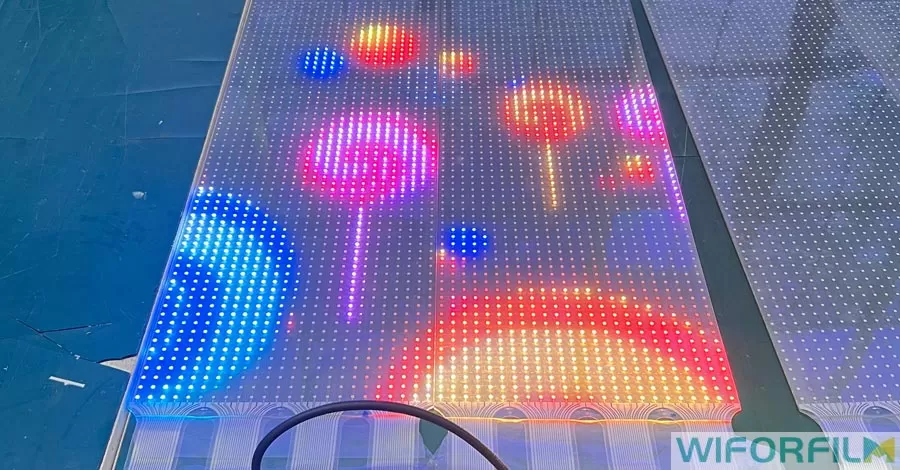
If you've ever walked past a glass storefront or building facade and noticed a display seemingly floating in mid-air on the window itself, you were looking at a flexible transparent LED film screen. At Wiforfilm, we design and manufacture these products every day — and we get one question more than any other: how does it actually work?
This article breaks down the real technology behind flexible LED transparent film screen — from the physics of light emission to the engineering of the film layers — in plain language, with no marketing fluff.
1. What Is a Flexible Transparent LED Film Screen?
A flexible transparent LED film screen is an ultra-thin, see-through display film that can be applied directly onto glass surfaces — windows, storefronts, glass walls, car windows, and more — without blocking the view behind it. When activated, it displays bright, full-color video and graphics. When off, it is nearly invisible.
Unlike traditional LED displays, which use solid panels with a fixed rigid structure, LED film screens are:
- Transparent: typically achieving 85%–95% light transmittance
- Flexible: can conform to curved or flat glass surfaces
- Self-adhesive: applied like a high-performance window film
- Ultra-thin: typically 1–3 mm thick, including adhesive layers
2. The Core Technology: How LEDs Produce Light Inside a Film
The heart of every LED film screen is the Light-Emitting Diode (LED) — a semiconductor device that emits light when an electrical current passes through it. This is a well-established physics principle known as electroluminescence.
In a transparent LED film, instead of large, bulky LED packages mounted on a PCB (printed circuit board), we use one of these two approaches:
A. SMD LEDs on a Transparent Substrate
Surface-Mount Device (SMD) LEDs — tiny red, green, and blue chips — are soldered onto an ultra-thin, flexible transparent substrate. The substrate holds conductive traces (wires) that are so fine they are nearly invisible to the naked eye. Each cluster of R, G, B chips forms one pixel.
The challenge here is keeping the conductive traces transparent. At Wiforfilm, we use ITO (Indium Tin Oxide) or fine metal mesh conductors that are optically clear at normal viewing distances.
B. COB (Chip-on-Board) or Micro-LED Film
In newer, higher-density products, Micro-LED chips are directly bonded to the film substrate using flip-chip technology, eliminating the wire bonds and packaging materials that would reduce transparency. This allows for higher resolution and even better see-through quality.
3. Layer Structure: What Is the Film Actually Made Of?
A transparent LED film screen is not just LEDs on plastic. It is a precision-engineered multilayer structure. From the outside in, a typical Wiforfilm product consists of:
- Protective outer layer: scratch-resistant, UV-stable PET (polyethylene terephthalate) film
- LED pixel array layer: SMD or Micro-LED chips mounted at defined pixel pitch intervals
- Transparent conductor layer: ITO or nano-silver mesh carrying electrical signals to each LED
- Diffusion / optical layer: optional micro-lens array to optimize viewing angle and brightness uniformity
- Adhesive layer: optical-grade pressure-sensitive adhesive (PSA) for bonding to glass
- Release liner: removed during installation
The total thickness of the film (excluding the glass it is applied to) is typically 1.5 mm to 3 mm depending on the pixel pitch and product specification.
4. Pixel Pitch and Transparency: The Engineering Trade-off
Two of the most important specifications for any LED film screen are pixel pitch and transparency, and they are inherently in tension with each other.
Pixel pitch is the distance (in millimeters) between the centers of adjacent pixels. A lower pixel pitch means more pixels per square meter, which means higher image resolution — but also less transparent area, because more of the film's surface area is occupied by LED chips and circuitry.
| Model | Pixel Pitch | Transparency | Recommended Viewing Distance | Best For |
|---|---|---|---|---|
| P4 | 4 mm | 90% | 2 – 8 m | Indoor showrooms, high-detail close-range displays |
| P5 | 5 mm | >85% | 3 – 10 m | Retail storefronts, mall atriums |
| P6 | 6 mm | 90% | 4 – 12 m | Architectural glass walls, hotel lobbies |
| P8 | 8 mm | 94% | 5 – 15 m | Retail windows, office building partitions |
| P10 | 10 mm | 94% | 6 – 20 m | Building facades, airport glass walls |
| P15 | 15 mm | 94% | 10 – 30 m | Large curtain walls, outdoor glass facades |
| P20 | 20 mm | 95% | 15 m+ | Super-large building exteriors, maximum transparency required |
The right model depends on three factors: viewing distance (closer viewers need smaller pixel pitch for a sharp image), transparency requirement (if preserving the glass view is critical, P15 or P20 is the better choice), and installation size (larger facades can use wider pitch without sacrificing perceived image quality). Our engineering team at Wiforfilm can recommend the optimal model once we know your glass dimensions and viewing conditions.
5. How the Image Is Controlled: Signal & Driver System
The LED film panel itself is a display surface — it needs a brain. Here is how the signal chain works:
Step 1: Content Source
Video content (MP4, images, live signals) is prepared on a media player or computer running LED control software. Common platforms include NovaStar and Linsn control systems, both of which are fully supported by Wiforfilm products.
Step 2: Sending Card
The sending card (also called a video controller) receives the video signal and converts it into a Gigabit Ethernet data stream compatible with LED display protocols.
Step 3: Receiving Card
Each section of LED film has a receiving card embedded or attached. The receiving card decodes the Ethernet signal and controls the current to each individual LED pixel using PWM (Pulse Width Modulation) — rapidly switching the LED on and off to control perceived brightness and color.
Step 4: Power Supply
Each film section is powered by a switch-mode power supply (typically 5V DC for modern film products). Low-voltage operation is a key safety advantage of LED film screens over older display technologies.
6. How the Film Adheres to Glass — and How Flexible It Really Is
The "flexible" in flexible LED film is real, but it has limits. Our film products can be rolled, curved, and applied to surfaces with a minimum bend radius of approximately 500 mm — sufficient for most architectural glass, curved shopfronts, and cylindrical pillars.
Adhesion is achieved using optical-grade PSA (Pressure-Sensitive Adhesive) — the same class of adhesive used in high-performance window films. This adhesive is:
- Optically clear — does not yellow or haze over time under UV exposure
- Re-positionable during installation — allows adjustment before final cure
- Removable — can be peeled off glass cleanly without leaving residue under normal conditions
For permanent or semi-permanent installations, structural bonding methods can also be used. Our installation team at Wiforfilm recommends professional installation to ensure bubble-free adhesion and correct electrical connections.
7. Brightness and Viewing Conditions
One of the practical questions we hear most is: "Will it be bright enough to see in daylight?"
LED film screens are measured in nits (candelas per square meter, cd/m²). Typical Wiforfilm products range from 2,000 to 5,500 nits peak brightness. For context:
- A standard indoor TV: ~300–500 nits
- A high-brightness outdoor display: 5,000–10,000 nits
- Direct sunlight (ambient): ~10,000–25,000 nits on a surface
For indoor window displays facing outside, our 3,500–5,500 nit products perform well in most daytime conditions. For north-facing windows or shaded facades, 2,000 nit products are sufficient and more energy-efficient.
8. IP Rating, Durability, and Safety Certifications
Transparent LED film screens installed on building exteriors or in wet environments need protection. All Wiforfilm outdoor film products carry a minimum IP65 rating — meaning they are fully dust-tight and protected against water jets from any direction.
Additional safety certifications relevant for commercial installations:
- CE Marking — European conformity (EMC Directive & Low Voltage Directive)
- UL Certification — North American electrical safety standard
- RoHS Compliance — restriction of hazardous substances in electronic equipment
Wiforfilm products are CE and RoHS compliant; UL certification is available on request for North American projects.
9. Common Applications
Understanding the technology helps clarify why LED film screens are used where they are:
- Retail storefronts: advertise while keeping the store interior visible — a key advantage over solid LED panels
- Building facades & curtain walls: transform glass architecture into a dynamic media surface without blocking natural light
- Showrooms & exhibitions: create floating display effects on glass partitions
- Vehicle glass (automotive): rear windows of buses and taxis used for advertising
- Stage & event design: transparent backdrop screens that let lighting and scenery show through
10. What Makes Wiforfilm's Products Different
As a manufacturer — not a reseller — Wiforfilm controls every stage of production:
- In-house PCB and film substrate fabrication with ITO and nano-mesh conductor options
- Customizable pixel pitch, size, and shape — we cut and configure to your glass dimensions
- Direct factory pricing with full OEM/ODM capability for branded products
- Technical support from our engineering team, not a call center
We have supplied LED film screens to projects in over 40 countries, from flagship retail windows in Dubai to media facades in South Korea. Every product is factory-tested at full brightness before shipment.
Conclusion
flexible LED transparent film screen work by combining ultra-small LED chips, transparent conductive layers, and precision signal control electronics into a thin, adhesive film that attaches to glass. The result is a display that is simultaneously see-through and capable of bright, full-color video — something that was impossible with older display technology.
The key trade-offs to understand are pixel pitch vs. transparency, and brightness vs. energy consumption. As a flexible LED transparent film screen manufacturer, Wiforfilm can help you navigate those trade-offs for your specific project — whether that is a single retail window or a 500 m² building facade.
Associated Products
You may also be interested in the following products:
Self-Adhesive Transparent LED Display Film - P5
Transparent LED Film Display Screen - P6.25
Flexible LED Transparent Film Screen - P8
Ultra Transparent Film LED Screen
Transparent Flexible Film Screen - P15
LED Crystal Film Screen
Transparent LED Screen Film - P4
Transparent LED Film Screen Price
How Transparent LED Film Screen Works:Complete Guide
Transparent LED Film Screen vs Traditional LED Display:Key Differences Explained
How to Choose Transparent LED Film Screen (2026 Guide)