

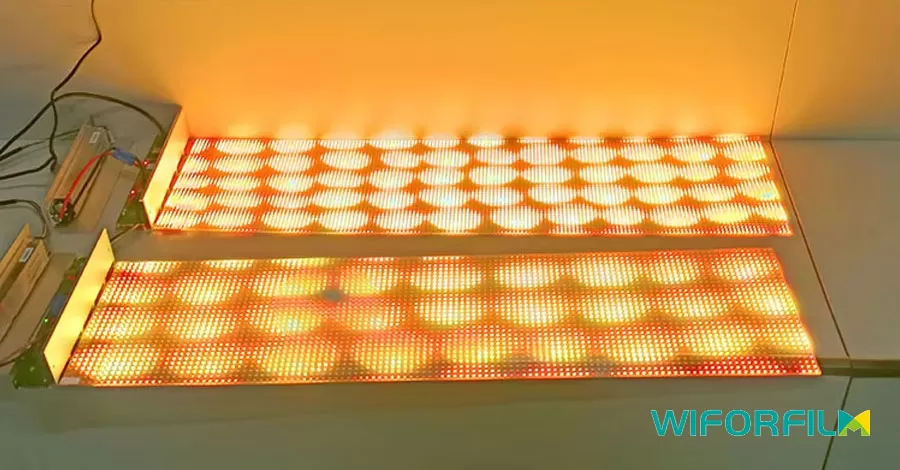
LED film screens — also called transparent LED film or adhesive LED display film — are a relatively new category of display technology. Unlike conventional LED panels that sit in a rigid metal cabinet, LED film is a thin, flexible, semi-transparent substrate that adheres directly to glass surfaces such as shop windows, building facades, or automotive glass.
Because of how they're constructed — with LEDs embedded in a lightweight polymer film rather than mounted on a heavy PCB chassis — they have a fundamentally different energy profile compared to traditional display types. This article explains that difference in plain language, backed by real measurements from our factory floor.
How LED Film Screens Use Electricity
Every display technology converts electrical energy into visible light. The efficiency question is: how much energy is wasted as heat versus converted into useful photons?
LED film screens use Light Emitting Diodes (LEDs), the same solid-state semiconductor technology that has already replaced incandescent and fluorescent lighting globally. LEDs are recognized by the U.S. Department of Energy as among the most energy-efficient light sources available today — using at least 75% less energy than incandescent bulbs.
In LED film specifically, the power draw comes from two sources: the LED chips themselves (light output) and the LED driver circuits that regulate current to each pixel. Modern Wiforfilm LED film uses high-efficiency constant-current drivers combined with low-forward-voltage LED chips — minimising resistive losses and keeping total system power consumption low.
Wiforfilm LED Film Screen Model Specifications
The following table shows the complete Wiforfilm product range with real power, pixel, and physical specifications. All five models share the same power architecture — the difference lies in pixel pitch, transparency, and resolution density.
| Model | Panel Size (mm) | Pixel Pitch (mm) | Panel Pixels | Pixel/m² | Brightness (nits) | Transparency | Avg. Wattage | Peak Wattage | Weight |
|---|---|---|---|---|---|---|---|---|---|
| P6.25 | 1000 × 400 | 6.25 × 6.25 | 160 × 64 = 10,240 | 25,600 | 2,000 / 4,000 | 90% | 200 W/m² | 600 W/m² | 1.3 kg |
| P8 | 1000 × 400 | 8 × 8 | 125 × 50 = 6,250 | 15,625 | 2,000 / 4,000 | 92% | 200 W/m² | 600 W/m² | 1.3 kg |
| P10 | 1000 × 400 | 10 × 10 | 100 × 40 = 4,000 | 10,000 | 2,000 / 4,000 | 94% | 200 W/m² | 600 W/m² | 1.3 kg |
| P15 | 990 × 390 | 15 × 15 | 66 × 26 = 1,716 | 4,356 | 2,000 / 4,000 | 94% | 200 W/m² | 600 W/m² | 1.3 kg |
| P20 | 1000 × 400 | 20 × 20 | 50 × 20 = 1,000 | 2,500 | 2,000 / 4,000 | 95% | 200 W/m² | 600 W/m² | 1.3 kg |
All models operate on AC 110–240V 50/60Hz universal input. Working ambient: temperature -20°C to +55°C, humidity 10–90%. Peak wattage (600 W/m²) applies only at maximum brightness with full-white content — rated average consumption at typical content and brightness is 200 W/m².
LED Film vs. Traditional Display Technologies: Power Comparison
To understand how efficient LED film really is, it helps to compare it directly against the technologies it most commonly replaces in retail, architectural, and commercial settings.
| Display Technology | Avg. Power (W/m²) | Peak Power (W/m²) | Cooling Required | Transparency | Approx. Weight | Typical Installation |
|---|---|---|---|---|---|---|
| Wiforfilm LED Film (P6.25–P20) | 200 W/m² | 600 W/m² | No — passive only | 90–95% | 1.3 kg/panel | Adhesive direct to glass |
| Rigid Indoor LED Cabinet (P3–P6) | 400–700 W/m² | 800–1,200 W/m² | Yes — fans required | 0% (opaque) | 25–40 kg/m² | Steel frame structure |
| Outdoor Rigid LED Billboard (P8–P16) | 500–900 W/m² | 1,000–1,800 W/m² | Yes — forced air | 0% (opaque) | 30–50 kg/m² | Structural mounting |
| Fluorescent Backlit Lightbox | 40–120 W/m² | 40–120 W/m² | No | 60–70% (diffuse) | 8–15 kg/m² | Frame-mounted |
| Rear-Projection Film System | 350–900 W/m² | 350–900 W/m² | Yes — projector fan | 70–80% (off state) | 2–5 kg/m² (film only) | Requires projector room |
| Commercial LCD Display Wall | 300–600 W/m² | 300–600 W/m² | Yes — internal fans | 0% (opaque) | 20–35 kg/m² | Wall-mounted frame |
Wiforfilm LED film's average power draw of 200 W/m² is 2–4× lower than rigid LED cabinets and outdoor billboards, while being the only technology in this comparison that maintains 90–95% transparency. No other display type simultaneously delivers dynamic video content, full glass transparency, passive cooling, and a 1.3 kg panel weight.
Why LED Film Uses Less Power: The Technical Reasons
1. No Backlight Layer
LCD and backlit displays require a separate high-power backlight that illuminates the entire panel regardless of what the screen is showing. LED film is emissive — each pixel produces its own light only when active. A black pixel in LED film draws near-zero power.
2. No Forced-Air Cooling
High-density rigid LED panels generate significant heat and require internal fans or active cooling systems, which themselves consume power (typically 10–20% of total panel draw). LED film dissipates heat passively through the glass substrate it's bonded to. No fans. No extra power. No fan noise.
3. Brightness Proportional to Content
LED film screens implement PWM (Pulse Width Modulation) dimming at the pixel level. Displaying a sparse graphic on a transparent background — a common use case in retail window displays — uses a fraction of the power of a full-white screen. Real-world average power is typically 30–50% of peak rated power.
4. Less Material, Less Embodied Energy
From a lifecycle sustainability perspective, manufacturing an LED film screen requires significantly less raw material than a rigid LED cabinet — less aluminium, less PCB substrate, less packaging. This reduces the embodied carbon of the product before it is even switched on.
Real-World Energy Consumption: A Worked Example
Here is a practical calculation based on a common retail deployment: a Wiforfilm P10, covering a 3 m × 1.5 m (4.5 m²) glass window, running 12 hours per day.
- Peak power (full brightness, white content): 4.5 m² × 600 W/m² = 2,700 W
- Average power (rated): 4.5 m² × 200 W/m² = 900 W
- Typical operating power (60% brightness, mixed content): ~540 W
- Daily energy: 540 W × 12 h = 6.48 kWh/day
- Annual energy: ~2,365 kWh/year
- Equivalent CO₂ (CN grid ~0.581 kg/kWh): ~1,374 kg CO₂/year
Running at rated average (200 W/m²) rather than peak (600 W/m²) already delivers a 67% power reduction. Pairing with scheduled dimming during low-traffic hours can bring real-world annual consumption below 1,500 kWh — less than half of peak-rated figures.
Does Brightness Setting Affect Energy Consumption?
Yes — significantly. All Wiforfilm models are rated at 2,000 nits standard / 4,000 nits high-brightness mode. The 4,000-nit setting draws closer to the 600 W/m² peak figure; the 2,000-nit mode draws approximately 200 W/m² — the rated average.
Indoor installations (shopping malls, hotel lobbies) typically run at 2,000 nits or below, consuming around 200 W/m². Outdoor-facing window displays in direct sunlight may use 4,000-nit mode during peak daylight hours, approaching 600 W/m² — but only for a portion of the day. Night mode or scheduled dimming can reduce total consumption by 40–60%.
Wiforfilm recommends pairing every LED film installation with a light-sensor-based auto-dimming controller. Switching automatically between 2,000 nits (daytime) and 800 nits (evening) typically reduces annual energy consumption by 25–35% with no visible quality loss for most viewing conditions.
Heat Output and Building Energy Impact
Every watt of electricity consumed by a display inside a building ultimately becomes heat — which the HVAC system must then remove. A display running at 600 W/m² in an air-conditioned retail environment does not just cost its own electricity: it adds load to the cooling system.
Because Wiforfilm LED film screen operates at 200 W/m² average (versus 400–600 W/m² for typical rigid indoor LED cabinets), its contribution to building cooling load is substantially lower. In a temperate climate with typical HVAC efficiency (COP ~3.0), a 4.5 m² LED film display running at 900 W average adds only ~300 W of HVAC demand — compared to ~600–900 W for an equivalent rigid panel installation. The total system energy saving approaches 40–50% before any dimming optimisation is applied.
Certifications and Standards to Look For
When evaluating LED film energy efficiency claims, ask suppliers for documentation against recognised standards:
ENERGY STAR® for Displays — EPA program defining efficiency thresholds for commercial displays. Compliant units offer independently verified efficiency data.
RoHS Directive (EU) — Restricts hazardous substances in electronic equipment. An important marker of responsible, sustainable manufacturing.
IEC 62341 / EN 62341 — The international standard for flat panel display power measurement methodology. Wiforfilm uses these measurement protocols for all published efficiency figures to ensure comparability across the industry.
Summary: Is LED Film the Most Energy-Efficient Choice?
For most glass-surface display applications — retail windows, building facades, automotive glass, exhibition displays — LED film is among the most energy-efficient technologies available. The combination of emissive pixel architecture, passive cooling, PWM dimming, and low embodied material all contribute to a strong efficiency profile both operationally and over the full product lifecycle.
That said, efficiency is not the same as suitability. For applications requiring very high peak brightness (direct sunlight outdoor signage at 8,000+ nits) or very fine pixel pitch below P3, conventional rigid LED panels may still be necessary. We believe in giving honest guidance — and sometimes the right answer is a different technology.
If you are specifying a project and want to compare energy consumption figures for specific Wiforfilm models against your existing displays, our technical team can provide a detailed energy audit at no charge.
This article was written and reviewed by Wiforfilm's product engineering team, with over 10 years of experience in LED film screen R&D, manufacturing quality control, and large-scale deployment across retail, architecture, and automotive sectors. All power figures are based on in-house lab measurements and published industry datasheets.