

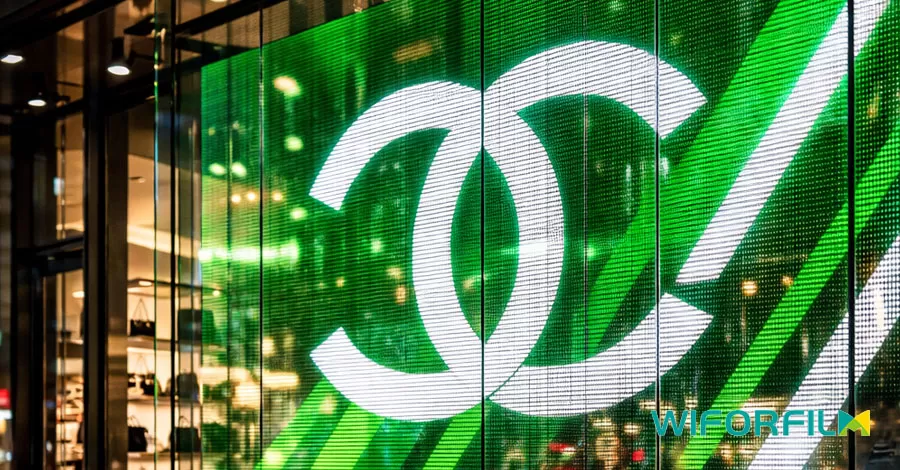
Working Principle: Self-Emissive Film on Transparent Substrate
Transparent LED film is a self-emissive display technology built on a flexible, optically clear PET (polyethylene terephthalate) substrate. Wiforfilm's product range uses two LED package families: the REE1515 (1.5 × 1.5 mm package, used in P6.25, P8, and P10 models) and the REE2121 (2.1 × 2.1 mm package, used in P15 and P20 models). Each package contains a standard R1G1B1 pixel configuration — one red, one green, one blue sub-pixel — capable of producing the full visible color spectrum through additive mixing.
The packages are mounted in a regular orthogonal grid on the substrate. The areas between LEDs are optically clear PET — they transmit ambient light and keep the scene behind the glass visible. This architecture produces two simultaneous optical effects: the film emits image content forward toward the viewer, while transmitting light through itself from the rear. Neither effect can be suppressed without affecting the other — this is the defining optical trade-off of transparent LED film.
Because the LEDs are self-emissive — each pixel generates its own light by electroluminescence — there is no backlight layer. When a pixel is off (displaying black), it emits zero light. The apparent "black" in the image is therefore the luminance of whatever is behind the glass at that moment. This is fundamentally different from a backlit LCD display, where black pixels still transmit residual backlight glow. The practical consequence: the background behind the glass is part of the display system, not independent of it.
Transparency Range
90 – 95%
P6.25: 90% · P8: 92% · P10: 94% · P15: 94% · P20: 95%
Measured in LED-off state per IEC transmittance standards.
Peak Brightness
2,000 / 4,000 nits
Both brightness tiers available across all five pixel pitch models. Selection is application-driven, not pitch-constrained.
Viewing Angle
160°
Horizontal and vertical, measured at 50% of on-axis luminance. Consistent across all models in the range.
Operating Environment
−20 to +55°C
Humidity: 10–90% RH (non-condensing). Input: AC 110–240V, 50/60 Hz universal supply.
The Physics of Visibility: Ambient Contrast Ratio (ACR)
The most important concept for evaluating transparent LED film in any real-world environment is Ambient Contrast Ratio (ACR). ACR is frequently confused with native contrast ratio — the figure quoted in product datasheets. They are not the same measurement.
Native contrast ratio is measured in a completely dark room with zero ambient illumination. It characterises the maximum theoretical performance of the display's emitters in isolation. No commercial installation replicates this condition. ACR is the contrast ratio actually perceived by a viewer under the ambient lighting of a specific site, and it is always substantially lower than the native figure.
For transparent LED film, the formula carries additional complexity: ambient light does not only reflect off the film's front surface — it also passes through the film from behind. At 90–95% transmittance, the majority of ambient light behind the glass reaches the viewer's eye, elevating the apparent luminance of what should be dark image regions. This is the core optical challenge specific to transparent film that does not apply to opaque LED panels.
A simplified engineering estimate for minimum required display brightness at a known ambient lux level:
This formula makes clear why no single brightness figure can guarantee visibility across all environments: Wiforfilm's 4,000-nit maximum requires ambient lux below approximately 8,000 lux to achieve ACR ≥ 5:1 without supplementary interventions. Understanding this threshold determines every product and installation decision that follows.
Wiforfilm Product Line Specifications (P6.25 – P20)
The table below presents the complete, verified product parameters for Wiforfilm's current transparent LED film range. All values are manufacturer production specifications drawn directly from the product datasheet.
| Parameter | P6.25 | P8 | P10 | P15 | P20 |
|---|---|---|---|---|---|
| Panel Size (mm) | 1000 × 400 | 1000 × 400 | 1000 × 400 | 990 × 390 | 1000 × 400 |
| LED Model | REE1515 | REE1515 | REE1515 | REE2121 | REE2121 |
| Pixel Configuration | R1G1B1 | R1G1B1 | R1G1B1 | R1G1B1 | R1G1B1 |
| Pixel Pitch (mm) | 6.25 × 6.25 | 8 × 8 | 10 × 10 | 15 × 15 | 20 × 20 |
| Panel Pixels (total) | 160×64 = 10,240 | 125×50 = 6,250 | 100×40 = 4,000 | 66×26 = 1,716 | 50×20 = 1,000 |
| Pixel Density (px/m²) | 25,600 | 15,625 | 10,000 | 4,356 | 2,500 |
| Brightness (nits) | 2,000 / 4,000 | 2,000 / 4,000 | 2,000 / 4,000 | 2,000 / 4,000 | 2,000 / 4,000 |
| Transparency | 90% | 92% | 94% | 94% | 95% |
| Viewing Angle (H/V) | 160° | 160° | 160° | 160° | 160° |
| Input Voltage | AC 110–240V, 50/60 Hz (universal) | ||||
| Peak Power (W/m²) | 600 | 600 | 600 | 600 | 600 |
| Average Power (W/m²) | 200 | 200 | 200 | 200 | 200 |
| Working Temperature | −20°C to +55°C | Humidity 10–90% RH | ||||
| Panel Weight | 1.3 kg | 1.3 kg | 1.3 kg | 1.3 kg | 1.3 kg |
Performance in Direct Sunlight and High-Lux Environments
Direct sunlight is the most demanding operating condition for any self-emissive display. Illuminance on a vertical south- or west-facing glass surface receiving direct solar beam radiation in East and Southeast Asia typically reaches 50,000–80,000 lux during peak hours. Horizontal surfaces in full summer sun can exceed 100,000 lux. Indirect sky radiation on a shaded north-facing façade ranges from 8,000–20,000 lux on a clear day.
Figure 1. Reference illuminance levels by environment. The gap between outdoor sun and a standard indoor space spans roughly three orders of magnitude.
Applying the minimum nits estimate (lux ÷ 2) to Wiforfilm's 4,000-nit maximum: the film is theoretically sufficient for ACR ≥ 5:1 at ambient lux up to approximately 8,000 lux — covering overcast sky, semi-outdoor atrium, and shaded canopy conditions. For direct solar exposure in the 50,000–80,000 lux range, 4,000-nit output alone cannot achieve ACR ≥ 5:1. This is a physical constraint of current LED film technology at any manufacturer's brightness tier, and it should be stated plainly.
| Environment | Typical Lux | Required Nits (est.) | 2,000-nit Tier | 4,000-nit Tier |
|---|---|---|---|---|
| Direct sun, S/W façade | 50,000–80,000 | 25,000–40,000 | Not suitable alone | Requires low-e / tinted glass |
| Indirect daylight, shaded | 8,000–20,000 | 4,000–10,000 | Not suitable alone | Viable; tinted glass + high-contrast content |
| Overcast sky | 2,000–5,000 | 1,000–2,500 | Marginal; bold content only | Good visibility; full content range |
| Semi-outdoor / atrium | 1,000–3,000 | 500–1,500 | Acceptable; high-contrast content | Excellent; full content range |
| Bright retail interior | 500–1,500 | 250–750 | Excellent; full content range | Excellent; can reduce drive current |
| Standard office / lobby | 200–500 | 100–250 | Outstanding; wide ACR headroom | Outstanding; drive reduction possible |
| Dim interior / evening | <50 | <25 | Dim to 300–600 nits to avoid over-brightness | Auto-dim to 300–600 nits; excellent quality |
Content Strategy for High-Ambient Conditions
When ACR is ambient-limited, content design is the most cost-effective compensating variable. Under high-lux conditions, content with white or high-luminance backgrounds, high-chroma color fills, and bold sans-serif typography maintains legibility far better than cinematic content with shadow detail or fine gradients. Design toward light, not away from it, for daytime content at high-lux installations.
Performance in Standard Indoor Lighting (300–1,000 lux)
The majority of Wiforfilm deployments — retail shop windows, hotel lobbies, commercial atriums, exhibition halls, and airport concourses — operate in ambient conditions of 300–1,000 lux. Both the 2,000-nit and 4,000-nit brightness tiers deliver fully satisfying image quality in this range without supplementary glass treatment.
At 500 lux, the 2,000-nit product achieves an estimated ACR of approximately 8:1 to 12:1, depending on surface reflectance and glass specification. This supports the full commercial content spectrum — rich color reproduction, readable text at normal viewing distances, and video content with moderate shadow detail. At 500 lux, the 4,000-nit product operates with substantial ACR headroom, enabling the controller to reduce LED drive current significantly, extending operational lifespan without any visible loss in image quality.
The Background Luminance Effect
The effective black level of a transparent LED film display is the luminance of the scene behind the glass, not a property of the LEDs. A film mounted on a glass partition with a brightly lit white-walled interior visible through it has a measurably higher effective black level — and lower perceived ACR — than the same film on a window looking to a dark exterior, even at an identical product specification. In transparent LED film, the background is part of the optical system.
For installations where the background is inherently bright, Wiforfilm recommends: an electrochromic or switchable privacy glass interlayer that darkens on demand; or a purpose-built dark backing panel on the interior face of the glass within the display zone, replacing the variable background with a controlled low-luminance reference surface.
Ambient Color Temperature and White Balance
The color temperature of ambient illumination measurably affects how the film's displayed white point is perceived. Warm sources (2,700–3,200 K, typical of incandescent or warm-white LED retail lighting) make the film's display appear relatively cooler by contrast. Neutral to cool sources (4,000–6,500 K, common in commercial ceilings) produce a more balanced ambient environment. Wiforfilm's control system supports per-channel white balance calibration to render perceptually neutral white under the specific ambient color temperature of each site.
Performance in Dim and Low-Light Environments (<50 lux)
Below 50 lux — a dimly lit museum gallery, a restaurant with ambient table lighting, or the exterior face of a building after dusk — transparent LED film delivers its peak contrast performance. At 20 lux ambient, even the 2,000-nit tier achieves an estimated ACR exceeding 50:1. Black regions read as genuinely dark, colors achieve full saturation, gradients render smoothly, and shadow detail in video content is fully resolved.
Downward Brightness Management in Low-Light
In low-ambient conditions, the engineering challenge inverts: the film must be reduced in brightness to avoid visual aggression relative to its environment. A film running at 2,000 nits in a 20-lux space creates extreme local luminance contrast, constitutes obtrusive light for adjacent spaces, and accelerates LED lumen depreciation unnecessarily. A nighttime operating level of 300–600 nits delivers excellent results in sub-50-lux environments — an 85–90% reduction from peak 4,000-nit drive current, cutting power from 600 W/m² to approximately 60–90 W/m².
Pixel Grid Visibility in Near-Dark Conditions
Below approximately 5 lux, the film's self-emitted light can become the dominant source in the viewer's visual field. Under these conditions, the eye's dark adaptation may resolve the physical LED pitch grid — the regular spacing of LED packages on the PET substrate — as a visible pattern overlaid on the image. This is not a defect; it is the array's spatial resolution limit becoming apparent when the display functions as the scene's sole light source. Reducing brightness to 200–400 nits fully resolves it by lowering the luminance gradient between lit and unlit substrate zones below the eye's acuity threshold at standard viewing distances.
Selecting the Right Pixel Pitch: Resolution vs. Transparency
Pixel pitch determines both image resolution and light transmittance simultaneously, and these properties move in opposite directions. Narrower pitch means more LEDs per unit area, higher resolution, and lower transparency. Wider pitch means fewer LEDs, lower resolution, and higher transparency. The correct pitch is determined by two primary factors: the expected minimum viewing distance and the transparency requirement of the installation.
Fine pitch
P6.25
Most popular
P8
Balanced
P10
High transparency
P15
Max transparency
P20
The minimum comfortable viewing distance scales with pixel pitch according to the angular resolution limit of normal human vision (approximately 1 arcminute per cycle at photopic adaptation). The practical engineering rule: minimum comfortable viewing distance in metres ≈ pixel pitch in millimetres × 1. At shorter distances, individual LED packages become visible and the image appears as discrete points rather than a continuous tone image.
Installation: Self-Adhesive Application on Glass and Acrylic
All Wiforfilm transparent LED film products are supplied with a pressure-sensitive adhesive (PSA) layer pre-applied to the rear face of the PET substrate, protected by a peel-off liner. The adhesive layer is integral to the film construction — no separate bonding agent, wet lamination process, or electrostatic mounting equipment is required.
Compatible Substrates
The PSA layer bonds to: flat glass (standard float glass, low-iron extra-clear glass, tempered safety glass, and laminated glass) and flat clear acrylic panels (optical-grade cast acrylic is recommended for the lowest haze value and best adhesive contact; extruded acrylic may exhibit higher residual haze). The film is not designed for curved, textured, fritted, or non-planar surfaces without a site-specific engineering assessment.
Glass Substrate Optical Considerations
Low-iron (extra-clear) architectural glass with visible light transmission (VLT) above 90% is the optimal substrate. Standard float glass contains residual iron oxide that imparts a characteristic green tint — most apparent in the display's whites and neutral greys. For color-critical applications (cosmetics, fashion, food retail), low-iron glass is the recommended substrate specification.
The PSA bond eliminates the micro-air-gap between film and glass that exists with frame-held or electrostatically mounted film. This air gap introduces measurable haze from internal reflections at the film-air and air-glass interfaces, and can produce Newton's ring interference fringing at oblique viewing angles. Direct PSA bonding eliminates both artifacts by creating a continuous optical interface.
Application Procedure
Installation sequence: (1) clean the glass or acrylic surface with isopropyl alcohol to remove all dust, oil, and moisture; (2) allow to dry completely; (3) peel the protective liner from the film; (4) align to the substrate; (5) apply with a firm squeegee or roller, working from the centre outward to eliminate air pockets. No curing time is required — the PSA bond achieves full strength on contact. Panels can be tiled edge-to-edge for multi-panel arrays; Wiforfilm supplies alignment guides and junction covers for seamless multi-panel installations.
Frequently Asked Questions
Can Wiforfilm transparent LED film be seen clearly in direct sunlight?
Not without supplementary glass intervention. In direct solar exposure of 50,000–80,000 lux, the physical requirement for ACR ≥ 5:1 is approximately 25,000–40,000 nits — well above the 4,000-nit maximum. This is a constraint of current LED film technology broadly, not specific to Wiforfilm. The correct configuration for direct-sun installations is the 4,000-nit film combined with a low-e or lightly tinted interlayer glass that reduces solar illuminance at the film surface to 5,000–15,000 lux, at which point 4,000 nits achieves ACR of 5:1–8:1 for high-contrast content. For shaded façades receiving indirect daylight (8,000–20,000 lux), the 4,000-nit product is viable with high-luminance content design and without glass treatment.
What do the two LED models — REE1515 and REE2121 — mean for performance?
The designation refers to physical package size: REE1515 packages measure 1.5 × 1.5 mm and are used in P6.25, P8, and P10. REE2121 packages measure 2.1 × 2.1 mm and are used in P15 and P20. The larger package in wider-pitch products allows higher per-LED drive capability while maintaining the same 2,000/4,000-nit panel output specification. Both families use the same R1G1B1 sub-pixel architecture and deliver identical color gamut and 160° viewing angle. End-users experience no functional difference between the two package types.
What does the film look like when the display is switched off?
In the off state, all LEDs are unpowered and the film is optically passive. On P20, transmittance is 95% — 95% of ambient light passes through the glass unaffected. On P6.25, transmittance is 90%. At normal viewing distances of 3 metres or more, casual observers do not perceive the film on the glass. Close inspection within 50 cm will reveal the regular LED package grid on the substrate. The PET substrate adds negligible haze on optical-grade film. The view through the glass in the off state is for practical purposes unaltered from unfilmed glass of the same specification.
How is the film installed — what equipment is needed?
No special equipment, adhesives, or electrostatic tools are required. The film ships with a built-in PSA layer protected by a peel-off liner. Procedure: clean the substrate with isopropyl alcohol; allow to dry; peel the liner; align the film; apply with a squeegee from centre to edges. The film bonds to flat glass (float, low-iron, tempered, or laminated) and flat clear acrylic panels. Surfaces must be planar, clean, dry, and free of coatings incompatible with pressure-sensitive adhesives. Curved or textured surfaces require a site assessment.
Why does the background behind the glass affect image quality?
Transparent LED film has no physical black state — the "black" in the image is the luminance of whatever is visible through the film. A high-luminance background (lit corridor, white-painted interior, skylight) raises the effective black level and reduces ACR regardless of the film's peak brightness. This is the same mechanism by which a front-projection system loses contrast in a lit room. For unavoidable bright backgrounds: use a dark backing panel within the display zone, electrochromic/switchable glass, or schedule content to avoid dark-region detail when background luminance is high.
What is the electrical supply requirement and how should circuits be sized?
All Wiforfilm products accept universal AC input: 110–240V, 50/60 Hz. No transformer is required for standard commercial supply in any major market. Electrical circuits must be sized to the peak power figure of 600 W/m², not the average of 200 W/m², to handle worst-case full-white maximum-brightness load. For a 10 m² installation at 600 W/m² peak, the circuit must support 6,000 W — approximately 27 A at 220V or 50 A at 120V — with appropriate safety margin per local electrical code.
When should I specify 2,000 nits vs. 4,000 nits?
Specify 2,000 nits for controlled indoor environments where ambient lux is consistently below approximately 1,500 lux — standard retail interiors, hotel lobbies, office partitions, museum spaces, and exhibition halls. Specify 4,000 nits for semi-outdoor applications, atrium glazing, outward-facing shop window displays, or any site where ambient lux during operating hours can exceed 1,500 lux. For direct solar exposure exceeding 20,000 lux, the 4,000-nit film requires supplementary glass treatment as described. Specifying 4,000 nits in a 500-lux indoor environment provides no perceptible image quality benefit — the binding constraint there is background luminance and glass reflectance, not film brightness.
Have a project in mind?
Our engineering team will assess your site conditions for free and give you a precise specification, not a generic recommendation.
Associated Products
You may also be interested in the following products:
Self-Adhesive Transparent LED Display Film - P5
Transparent LED Film Display Screen - P6.25
Flexible LED Transparent Film Screen - P8
Ultra Transparent Film LED Screen
Transparent Flexible Film Screen - P15
LED Crystal Film Screen
Transparent LED Screen Film - P4
Transparent LED Film Screen Price
How Transparent LED Film Screen Works:Complete Guide
Transparent LED Film Screen vs Traditional LED Display:Key Differences Explained
How to Choose Transparent LED Film Screen (2026 Guide)